Home Occupation Permit for Personal Trainers: What You Need Before Clients Come to Your Home Gym
Updated 2025 · 8 min read
You've built out your garage gym, bought the bumper plates and a squat rack, and you're ready to train clients at home. Before that first session, one question needs an answer: do you need a permit to train paying clients at your residential address?
The short answer is yes — in virtually every U.S. city. The moment a client pays you for a service at your home, your residence has taken on a commercial function that residential zoning is designed to regulate. The permit that authorizes this is called a home occupation permit.
Personal trainers, strength coaches, yoga instructors, and fitness professionals who train paying clients at their own residential address — in a dedicated home gym, garage, basement, or backyard. If you train clients at their homes or at a commercial gym, different rules apply.
Why Client Visits Are the Key Trigger
Home occupation permits exist to prevent residential neighborhoods from taking on the traffic, noise, parking, and signage characteristics of commercial zones. For most home businesses — accountants, consultants, online sellers — clients never visit, so zoning impact is minimal. Personal training at home is different. Clients drive to your address, park, enter your home, and work out for 45–90 minutes. From a zoning perspective, this is indistinguishable from a small fitness studio in a residential neighborhood.
The specific triggers in most city ordinances:
- Client visits — customers coming to the home for services
- Noise — weights, equipment, or music audible outside the home
- Parking — additional vehicles beyond normal household use
- Equipment storage — large commercial-grade equipment occupying significant square footage
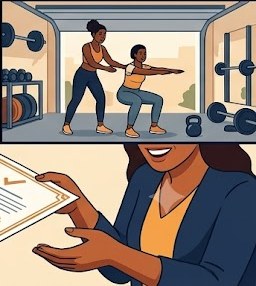
What the Permit Allows and Restricts for Trainers
| Restriction | Typical Rule | Impact on Training |
|---|---|---|
| Client visits per day | 4–8 clients/day, or 1–2 at a time | Limits class size and back-to-back scheduling |
| Hours of operation | Often 7am–8pm weekdays | No 5am or 9pm sessions in many cities |
| Employees | No non-resident employees at the home | Can't bring in a co-trainer |
| Signage | No exterior signs | No advertising your home address publicly |
| Noise | Not detectable at property line | Soundproofing may be required for garage gyms |
| Square footage | Business use typically limited to 20–25% of home | A 400 sq ft garage gym in a 1,200 sq ft home may be borderline |
Minor vs. Major Home Occupation: Which Applies to Trainers?
Minor Home Occupation
No client visits. For trainers: online coaching, programming clients remotely, virtual sessions only. Simple application, often free or under $50, approved in 1–2 weeks.
Major Home Occupation ← You Are Here
Client visits allowed up to a daily limit. Requires more documentation, possible neighbor notification, $75–$250 fee, 2–6 week approval time. Required for in-person home gym training.
For personal trainers training clients at home, a Major Home Occupation permit is the appropriate tier. Don't apply for a Minor permit just to avoid extra steps — client visits will exceed what's allowed, and a single neighbor complaint can result in revocation.
Noise and Equipment: The Practical Problem
Even with a valid permit, noise complaints are the #1 reason personal trainers lose home occupation authorization. A dropped barbell in a garage at 6am is audible well beyond your property line. Steps experienced home-gym trainers take:
- Horse stall mats + rubber gym flooring (at least 3/4" thick) under all lifting areas to absorb impact
- Deadlift platforms with embedded rubber to reduce bar contact noise
- No music audible outside — headphone setups or well below outdoor-audible volume
- Proactive neighbor communication — a heads-up before you start goes further than any permit
- Schedule sessions 7am–7pm — far less likely to generate noise complaints than early-morning or late-evening sessions
🏋️ Recommended: Rubber Gym Flooring Tiles
Heavy-duty interlocking rubber tiles protect your floor and dramatically reduce noise transmission from dropped weights and equipment movement — an essential compliance investment for any home gym taking paying clients. Look for tiles at least 3/4" thick.
View on Amazon →As an Amazon Associate, we earn from qualifying purchases.
Liability Insurance: Required Before the First Client
A home occupation permit provides zero liability protection. Before training a single paying client at your home address, you need:
- Professional liability (E&O) insurance — covers claims of negligent instruction or training-related injury
- General liability insurance — covers bodily injury or property damage at your premises. Your homeowner's policy almost certainly excludes business activities
- Homeowner's policy notification — call your insurer before your first client session. Operating a client-visit business without notifying your insurer can void your entire homeowner's policy
Step-by-Step: Getting Permitted as a Home Trainer
Find your city's planning or zoning department
Search "[your city] major home occupation permit application." Download the application and read the ordinance section on home occupations — look for client visit limits, hour restrictions, and noise rules.
Prepare your business description
Be specific: "Personal fitness training. One client at a time, maximum 6 sessions per day, 7am–7pm, Monday–Saturday. No employees. No exterior signage. Training conducted in dedicated garage gym." Vague descriptions slow approval.
Calculate your space usage percentage
Some Major Home Occupation applications require a floor plan showing business square footage as a percentage of total home square footage. Know your numbers: gym area ÷ total home sq ft × 100.
Submit and pay the fee ($75–$250)
Neighbor notification may be part of the process — the city usually handles the mailing. Ask if there's a separate notification fee.
Notify your insurer and apply for any required business license
Once approved (2–6 weeks), notify your homeowner's insurer and apply for any general business license your city requires separately from the zoning permit.
Retroactive applications are accepted in most cities. Apply as a new applicant — describe the business accurately. Most zoning departments treat first-time violations as administrative rather than punitive when the business is cooperative and low-impact. See what typically happens →
Frequently Asked Questions
Yes, in most cities. The number of simultaneous clients doesn't change whether you need a permit — it affects which tier applies. Any paid client visiting your residence triggers the home occupation permit requirement in cities that have one.
Usually not. Home occupation ordinances typically apply to any structure on the residential parcel, not just the main dwelling. Some cities address accessory structures specifically — check your city's ordinance language.
No client visits, no noise, no parking impact — online-only training is typically treated as a low-impact home office occupation. In most cities, you'd fall under the Minor home occupation category, or may be exempt entirely.
For Major Home Occupation permits, many cities mail notices to adjacent property owners (typically within 100–300 feet). They're given a comment period (usually 10–15 days) to raise concerns. The vast majority of personal training applications receive no objections. If a neighbor does object, the application goes to a hearing where you can address their concerns.
Yes. A city permit overrides nothing in your HOA's CC&Rs. HOAs can independently prohibit client-visit businesses regardless of city zoning. Review your CC&Rs before investing in your home gym. See our full HOA guide →