Do You Need a Home Occupation Permit to Sell on Etsy?
Updated 2025 · 7 min read
Most Etsy permit advice ends with "check with your local government," which isn't helpful when you need to know right now. Here's the direct answer: whether you need a home occupation permit for your Etsy shop depends almost entirely on what you're selling and whether customers or deliveries come to your home.
Digital downloads only → Usually no permit needed in most cities.
Handmade physical goods → Permit likely required in most U.S. cities.
Food, baked goods, candles, cosmetics → Permit required + additional state licensing.
Vintage / resale → Permit required in most cities; resale certificate also needed.
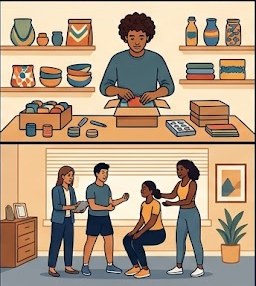
Why a Home Occupation Permit Comes Up for Etsy
A home occupation permit is a local zoning authorization — issued by your city or county — that allows you to run a business from a residential address. Most residential neighborhoods are zoned exclusively for housing. The permit says this specific business activity is compatible with residential use.
The requirement comes from your city government, not Etsy. Etsy won't check whether you have a permit. Your local building or planning department may never find out either — until a neighbor complains, you get audited, or you try to file business taxes.
Digital Downloads: Usually Exempt
If you sell exclusively digital products — printables, SVG files, templates, Lightroom presets, digital art — you're operating a business with essentially no physical footprint. No inventory, no shipments, no customer visits. In most U.S. cities, this is either explicitly exempt or so low-impact that enforcement is essentially nonexistent.
However, a handful of cities — notably San Francisco, Seattle, and Portland — technically require a permit for any business activity conducted from a residential address, regardless of type. Search "[your city] home occupation permit ordinance" to check your specific city's exemption language.
Handmade Physical Goods: Most Sellers Need a Permit
If you make and ship physical goods — jewelry, ceramics, woodwork, candles, stickers, clothing — you almost certainly need a home occupation permit in any city with a functioning zoning code. The moment you regularly receive raw material shipments, store inventory at home, and send packages via commercial carriers, your address has taken on commercial characteristics.
The good news: for a solo maker working out of a spare bedroom, applications are almost always approved. The permit confirms you're operating within residential norms — it doesn't restrict legitimate small business activity.
Food, Cosmetics, and Body Products: Two Layers Required
If you sell anything that goes on or into the body — baked goods, lip balm, soap, lotion, bath bombs — you need a home occupation permit plus additional state-level licensing. Most states have Cottage Food Laws that allow limited home food production without a commercial kitchen, but these laws cap annual revenue (typically $25,000–$75,000) and require labeling. Your county health department is the right starting point for food licensing.
Cosmetics sold in interstate commerce (which Etsy sales are) fall under FDA oversight. Labeling requirements and ingredient safety standards apply regardless of your permit status.
Resale and Vintage: Two Documents
If you source and resell vintage items or wholesale goods, you need: (1) a home occupation permit for operating a resale business from home, and (2) a resale certificate (seller's permit) from your state's department of revenue, which allows you to buy goods for resale without paying sales tax twice. These come from different agencies. Many Etsy resellers miss the resale certificate and end up double-paying sales tax.
How to Find Your City's Requirements
Search "[your city name] home occupation permit" or call your city's planning department directly. Look for: whether your business type is exempt or covered, inventory and shipment restrictions, and any landlord consent requirement if you rent.
In most cities, retroactive applications are accepted without penalty for first-time, low-impact operations. The process is identical to a new application. Read about consequences and how to come into compliance →
📦 Recommended for Home Sellers: Shipping Scale
Once permitted, a dedicated postal scale prevents shipping overcharges and eliminates guesswork at the post office — one of the most practical tools in any Etsy seller's home workspace.
View on Amazon →As an Amazon Associate, we earn from qualifying purchases.
Step-by-Step: Getting Permitted as an Etsy Seller
Find your city's planning or zoning department
Search "[city] planning department." This is the agency that issues home occupation permits — not the tax office, not the state.
Read your city's home occupation ordinance
Check the definition of "home occupation." Note exemption language for no-customer, no-employee businesses.
Complete and submit the application
Most applications are one to two pages and cost $0–$150. Many cities now accept online applications.
Layer on product-specific licenses
Food sellers: county health department. Cosmetics: FDA labeling + state licensing. All sellers: confirm if a general business license is also required.
Free Application Checklist
Every document, fee, and question to ask before you file — printable PDF.
Frequently Asked Questions
No. Etsy does not require sellers to hold a home occupation permit. The requirement comes from your local city or county government's zoning rules — independent of Etsy's platform policies.
In most cities, no. Digital-only sellers typically don't trigger the inventory, shipping, or customer-visit thresholds that home occupation ordinances regulate. However, some cities require a permit for any business activity from a residential address. Check your city's specific ordinance.
Storing inventory off-site can reduce the storage trigger. However, if you're still making, photographing, packing, and shipping from home, the production activity may still require a permit depending on how your city defines "home occupation."
In cities that require one, yes. Consequences typically start with a notice of violation and an opportunity to come into compliance. Fines range from $100–$500 per violation in most cities. See our full guide →
Yes. Home occupation permit requirements are triggered by the business activity at the address, not by income level or whether it's your primary job. A part-time shop generating $500/month is treated the same as a full-time operation under most zoning ordinances.